History
1020
St. Michael and All Saints Church has been here for almost a thousand years, in one form or another. Originally a small wooden chapel, it catered for those working in the Berechurch area (Berechurch means “Church in the Cornfields”) to save them having to walk all the way to St John’s Abbey to worship.
1500
The Church is now a brick and stone building with an embattled West Tower. The original foundation is 14th Century, but it was rebuilt in 1500.
Berechurch Hall, the mansion of West Donyland, is first mentioned as being acquired by Sir Thomas Audley, Lord Chancellor to King Henry VIII and Speaker of the House of Commons, after St. John’s Abbey was dissolved. Members of the family built the little family church, where many of them are buried.
1537
Up to this year the church had been served by vicars of Holy Trinity Church. It now became a parochial church and the Audley family became their patrons. It is recorded that the Parish of Berechurch numbered 37 people.
1544
Thomas Audley had a very dark side to his character. It is said that after he died on 30th April, on his black marble gravestone, which is situated in Saffron Walden, it is written, ‘That the stone was no blacker nor harder than his heart’!
1624
Robert Audley buried in the church.
1648
Sir Henry Audley designed his own tomb before he died.
1661
The church was held in plurality with Layer-de-la-Haye.
1872
The church was rebuilt using material from the old church.
1912
The church was now held with St.Mary’s-at-the-walls.
1936
The church was held with All Saint’s, Shrub End.
1954
With the growth of Monkwick estate, the church was held singly.
1960
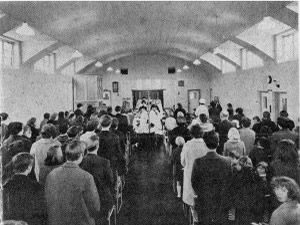
The post World War Two years saw a boom in building and the population of Colchester rapidly increased with the influx of people displaced from London. New estates sprang up to the South. The Monkwick Estate was fully within the ancient parish of Berechurch, swelling the population to several thousand. As part of the provision for the new community a dual-purpose Church Hall (St. Margaret’s) and Vicarage were built at the junction of Mersea Road and Stansted Road. This was used as a church on Sunday and a community hall in the week.
1966
The decision was made that a new church building should be built, but rather than hiring a construction company the congregation took on the bulk of the construction work themselves – yes, we built our own church!
1968
The lorry driver’s face was a study the day he and his load of 8,000 bricks arrived at the site of the new church, for waiting to unload the bricks were a group of eager housewives. “You’re never going to do this yourselves!” gasped the lorry driver. “Why not?” retorted the group proudly. “We’re helping to build the church.”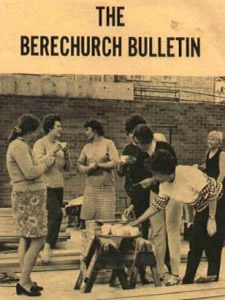
And since that bitterly cold day the ladies of St. Margarets Church, near Colchester, Essex, have never once sat back and let their husbands do all the heavy work for their “do-it-themselves” church. Instead, they’ve put on their jeans and boots, rolled up their sleeves and got cracking with jobs like unloading lorries of bricks and timber, preparing the strips for the roof, and finishing off all the brickwork which their husbands learnt how to lay at evening classes.
“The men could only work in the evenings and weekends so it would have taken them far longer if we hadn’t helped,” said Violet Radley, an industrious corner-stone of the housewives’ building corps. “It was our Vicar who suggested we unload the lorries because they always delivered during the day when our men weren’t around. Altogether we’ve unloaded over 45,000 bricks, dozens of 24foot long lengths of timber and eight half-inch glass doors. It took eight of us to lift each one!
“We had to ask that very first lorry driver how to unload his bricks. He told us how to hold three together like a wafer of ice cream. Then we formed a chain to the hut where the materials were being stored and passed them along. I won’t say we didn’t drop any bricks. But at least none landed on our toes!” Violet, a cheery forty-two year old with two teenage children. recalled their first “brickies” experience as we stood on the muddy building site beneath the church’s skeleton frame with the main roof beams soaring into the sky.
In the hut, ten of the housewives were cutting the strips with an electric saw. Later, in her comfortable home a stone’s throw from the site, Violet showed me photos of the completed model of the church. Its design is futuristic with a special triangular chimney for the light to beam through to the altar area. It will seat two hundred and fifty in a semi-circle.
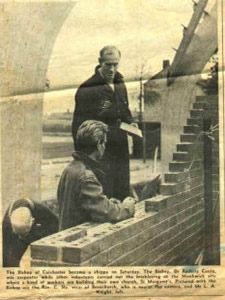
At present, parishioners use a hall by the building site for both their worship and social events. The idea to build their own church came to Jean Sly, the Vicar’s pretty young wife, in the middle of the night. She woke up her husband who thought the scheme crazy. But next morning, after going into the money aspect of things, he changed his mind. When the church is finished, by the end of next year, the bill should be about £15,000 – under half the normal cost.
“When I first heard Mr Sly say we would do it ourselves, I thought: crumbs we’ll never manage,” said Violet. Now she and the other ladies, there’s a hard core of about a dozen, like to think that the men could not have managed without them.
To protect her hands against the rough work, Violet started off wearing rubber gloves. But she got through so many pairs, that she settled for some old leather gardening gloves. And to help her husband, Fred, a forty-four year old electrician, who works nights on the site, to beat the cold during the wintry months, she knitted him a bobble hat and half-mittens without finger covering. The outfit was a huge success and Violet found herself knitting for the other men as well.
Like the other husbands, Fred is justifiably proud of his wife’s achievements. “When I tell him what we’ve been doing on the site, he’ll say, “That’s not women’s work”. Then we both laugh and next day all of us housewives carry on as usual,” said Violet, smiling.
Her son, Andrew, helps at the site too, and daughter Linda has made a neat purple and orange embroidered hassock, one of two hundred the ladies are sewing for the church. “All our families have been involved with the project. Even the babies and 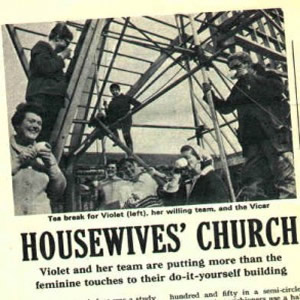 toddlers, as they’re brought along to the site so that their mums can do some work;” said Violet.
The ladies’ final task, apart from their continuous fund-raising efforts, is to lay glass mosaic on the floor of the altar dais and church entrance. “After it’s all finished we’ll have loads of our own decorating and gardening to do,” said Violet. “We’ve not had a minute to look after our own homes.”
GLENDA NIELD
After 6 years construction the new building was opened. It was dedicated on 11th December1973 by the Bishop of Chelmsford, the Rt. Rev John Trillo. The existing dual use building becoming simply St. Margaret’s Hall.
1975
The old St. Michael’s Church was now redundant and sold off, although old Audley Chapel was kept in its original state and can still be visited.
2023
The church was held with St. Stephen’s. This year was the fiftieth anniversary of the opening of the new building. A celebration was held.
Rectors serving West Donyland.
1275 William Fraunk
1295 Robert
1324 Richard de Frinton
     Thomas de Bathon
1329 Adam at Holme
1335 Thomas de Kenton
     Richard Honey
1349 John Gosse
1373 Thomas Gowlther
     John Bertlet
1382 John Mayn
1383 Richard Crawley
     Richard Chamberlayne
1406 Richard Watton
1409 John Wiltoneshert
1410 John Mallyng
      William Page
1428 William Stones
1431 Richard Sukley
1460 Robert Camell
     Robert Cropping
1463 Thomas Banaster
1470 Thomas Kyrkham
1472 John Lokworth
1495 Henry Corkar
     Richard Gildinwater
1505 Edward Squyre
1510 John Dyson
1511 Ralph Tylney
1518 John Swan BA
1526 Thomas Nichols
1530 Robert Dent MA
1536 William Jaye MA
c1567 William Nevard
1585 Thomas Holland
1590 Philip Blunt
1592 William Cole BA
1598 William Read
1612 William Nutter
1615 William Adams
1627 George Rush
1633 Theophilus Roberts MA
1670 Thomas Buxton
1661 Thomas Parker
1698 Richard Reynolds
1700 Thomas Ludkin
     Christopher Gibbon
1755 Stephen Aldrich
1769 John Stevenson
1826 Edward Crosse
1835 Matthew Dawson Duffield
1842 John Richard Errington
1845 John Heyliger Dewhurst
1870 Thomas Oldmeadow Price
1912 Grenville Turner Brunwen Hales
1933 George Augustus Campbell
1936 Leonard Herbert Tennant
1938 William Henry Williams
1953 Henry Richard Darby
1954 Arthur Stuart James Holden
1961 Samuel John Tyler
1965 Christopher John Sly
1975 Christopher John Alfred Harvey
1994 Robert A. Wilkinson
2007 Andrew Ian Fordyce
2023 Lorraine Watts
2024 Anna Davis